Categories
Bookkeeping

Bookkeeping services pricing guide: How to nail your pricing Karbon resources

how much to charge for bookkeeping

Then you multiply 40 by your old hourly rate of $40, and you decide to charge a flat $1,600/month. If you’re having trouble determining how much to charge a client, it’s perfectly fine to start out working with them at an hourly rate and moving to a fixed rate later on. At the beginning of your working relationship, there could be quite a bit of cleanup you have to do for the client’s books, and that can be time consuming. You’re also learning their business and don’t know exactly what tasks you will be doing. There can be multiple variants that play in the pricing factor.

Automate common bookkeeping tasks and grow your client base

As their bookkeeper, you’re not just offering them a service, you’re offering them peace of mind, and that’s a value they’re more than willing to pay for. Each pricing model should be crafted with care and consideration to reflect the unique services provided to small, medium, and large-sized clients alike. In addition to basic bookkeeping, they might require additional services like payroll processing, sales tax returns, and accounts payable and receivable management.

How to Increase Your Accounting Firm Valuation

For example, if you have the time to handle bookkeeping yourself, you might continue to do so to save money. On the other hand, if you’d like to use the time you spend bookkeeping focusing on other aspects of your business, then the cost of a bookkeeper may be worth it. Whether you opt for basic bookkeeping or full-service bookkeeping and what does ‘we are going to get one thing on the books’ imply accounting, either option can help you be better prepared come tax season. And now that you know the answer to the question “How much does a bookkeeper cost? ” you may wonder what exactly a bookkeeper does and the different types of bookkeeping services you can pay for.

Types of bookkeeping: Basic vs. full-service accounting

Even if you hire a part time bookkeeper, your management would still have to review their work. Offering custom services means tailoring your services to each client’s net sales defined needs. This is a good option if you want to offer a wider range of services. For custom pricing, you’ll need a general idea of how much you charge for each service and then consider if the total cost for all the services for the client is reasonable. With customized pricing, you can either charge a flat monthly fee or hourly. Businesses typically expect certain services to be part of bookkeeping, but providing additional offerings that add value to your clients’ businesses can justify charging a higher fee.

If the cost is similar to that of an actual bookkeeper for performing the same tasks, then it may be better just to pay someone to do the job. Bookkeeping services are necessary for businesses of all sizes. Whether you decide to outsource your bookkeeping or do it with an in house bookkeeper, you should be aware of the costs involved. As a small business owner, you want to make well-informed decisions about financing your bookkeeping expenses, and you want to do it correctly. The type of bookkeeping services you offer will also affect your pricing.

  1. Every client is unique, and their needs will vary greatly depending on the size and nature of their business.
  2. You may also consider throwing in other costs, like a fee for an initial consult, to your pricing structure.
  3. But remember, transparency, clarity, and value-based conversation are key.

How to Price Bookkeeping Services for Small, Medium, and Large Clients

how much to charge for bookkeeping

Then we will compare this to the fixed-rate monthly pricing I charge for bookkeeping services along with the bookkeeping tasks I do for each one. My goal is to help you understand what these breakdowns look like for each client. In general, most bookkeepers charge an hourly rate or a flat fee per month. When you decide to switch away from your average hourly rates to a flat monthly fee, your instinct is to still base it on your time. You discover that it takes around 40 hours per month to complete your monthly bookkeeping tasks.

Since you often do the same work for multiple clients, there’s no reason to start from scratch each time you calculate your pricing. This article will look at the factors that should go into your pricing, how to market your services, the difference between margin and markup and mistakes to avoid when calculating your prices. Even if you switch to fixed fees or a value pricing structure for your main bookkeeping services, you may have additional services that command a premium. As you can tell, how much you should charge as a bookkeeper can vary based on a lot of factors. So, you need to take your time when setting prices for your services. One way you can determine how much to charge is to tie each task to a dollar amount.

Categories
Bookkeeping

Accounting Software for Small Businesses

wave apps accounting

While the free plan still exists, a paid plan is now available. Wave offers accrual-basis accounting only, not cash-basis accounting. Today’s leading accounting platforms offer standard security features, such as data encryption, secure credential tokenization and more. While human error will always play some role in security breaches, you can be confident in your accounting platform when it comes to keeping your information safe.

The Best Corporate Credit Cards For Businesses

We spend hours researching and evaluating each accounting software system we review at Merchant Maverick, placing special emphasis on key characteristics to generate our ratings. Users of the free plan are limited to using Wave’s Help Center or Mave, the support chatbot. Fortunately, the Help Center provides plenty of guides and information to help with most issues, and the software is intuitive enough that this support option will be sufficient for most users. Unfortunately, Wave does not offer a project management feature. At the time of our last review, we noted that Wave “has always been and always will be free,” and that the company planned to maintain this pricing structure following its acquisition by H&R Block.

Accounting softwarethat works as hard as you do

Still, Wave’s free plan offers a good set of features and could be suitable for sole proprietors or smaller businesses with basic accounting needs. Accounting software helps business owners understand how money flows in and out of their businesses. This can help you save time and make financial decisions quickly. We also ensure that the software offers most standard accounting features and reports, awarding higher rankings to those that provide advanced services, like tax filing.

Keep track of your business health

Refer to our Advertising Disclosure to learn more about how we earn compensation from affiliate partnerships and how we maintain our independent editorial integrity. With this release, we’re waving bye to bugs and hello to stability improvements. Thanks for using Wave to help you stay more in control of your business while on-the-go. Automate the most tedious parts of bookkeeping and get more time for what you love.

  1. Now, many standard features (such as automatic importing of bank transactions) are only available if you purchase a monthly or annual plan.
  2. But for small-business owners who want to eventually expand their businesses and hire an employee or two (or more), just know that Wave doesn’t make it easy to add payroll software beyond its own.
  3. Our (non-judgmental) team of bookkeeping, accounting, and payroll experts is standing by to coach you—or do the work for you.
  4. Furthermore, customers using the free Starter plan will have limited support options.

Explore more details on the competition in our full roundup of the best accounting software for small businesses. Also, Wave Accounting only offers self-serve customer support. If you have a question or issue, you can browse the help center or reach out to Mave, the automated chatbot. If you do want live support, you’ll need to invest in an Advisor or paid service. We built our payroll tool for small business owners, so it’s easy to use AND teaches you as you go. Give your customers the option of paying with one click using a credit card, bank transfer, or Apple Pay.

Data Not Linked to You

Have an eye on the big picture so you can make better business decisions. Our robust small business accounting reports are easy to use and show month-to-month or year-to-year comparisons so you can easily identify cash flow trends. Overall, we rate Wave 3.9/5 and recommend it for business owners looking for a cheap — or in most cases, free — accounting software option. There are several additional Wave products that you can purchase for your business. Wave Payroll has two options ranging from $20 – $40/month + $6/employee or contractor. Tax service payroll is available in 14 states, while self-service payroll is available in the remaining 36 states.

Most importantly, it doesn’t sync with any third-party payroll providers. You can enjoy features such as unlimited income and expenses tracking, digital receipt upload and transaction management purchase discounts returns and allowances and access its invoice mobile app at no cost. Wave Accounting offers free software, meaning you won’t need to submit a credit card or payment information to use it. It can help you manage your bookkeeping, accounting and invoicing processes through a few internal integrations. Xero also doesn’t support multiple businesses, so pricing can add up quickly for some users. And it’s worth noting that while Xero has more features, the software also has a steeper learning curve than Wave.

wave apps accounting

In the past, Wave generated revenue from its credit card processing, Wave Payroll, and bookkeeping services. Now, the company has added a paid accounting software plan. While Wave is free to use, it doesn’t offer multiple plans to increase its functionality. It lacks some of the useful features you may find in other accounting software, such as project management, time tracking and inventory management. However, there are a few features the software is still lacking.

Categories
Bookkeeping

Average Collection Period: Understanding Its Importance in Business Finance

average collection period formula

This not only improves cash flow but also fosters positive relationships with your clients. By adopting these practices, businesses can minimize days sales outstanding (DSO) and improve their overall difference between tangible and intangible assets with examples financial health. To really understand your accounts receivables, you need to look at this metric in tandem with related metrics like AR turnover, AR aging, days payable outstanding (DPO), and more.

How average collection period affects cash flow

In conclusion, external factors such as economic conditions, competition, and customer behavior significantly influence an organization’s average collection period. By carefully considering the impact of external factors on their business, companies can make informed decisions that maximize their cash flow while minimizing their days sales outstanding. By focusing on streamlined collections processes, companies can collect payments faster and reap the benefits that come from a shorter average collection period. The average collection period is an essential metric that indicates the length of time it takes for a business to receive payment from its customers for accounts receivable. In essence, it represents the average number of days between recording a credit sale and receiving payment from clients.

Average Collection Period: Understanding Its Importance in Business Finance

The best way that a company can benefit is by consistently calculating its average collection period and using it over time to search for trends within its own business. The average collection period may also be used to compare one company with its competitors, either individually or grouped together. Similar companies should produce similar financial metrics, so the average collection period can be used as a benchmark against another company’s performance. When analyzing average collection period, be mindful of the seasonality of the accounts receivable balances. For example, analyzing a peak month to a slow month by result in a very inconsistent average accounts receivable balance that may skew the calculated amount. A low average collection period indicates that the organization collects payments faster.

Analyze Payment Terms and Policies

More sophisticated accounting reporting tools may be able to automate a company’s average accounts receivable over a given period by factoring in daily ending balances. The average collection period is limited in that it does not have much meaning on its own. However, comparing it to previous years’ ratios or the credit terms of your company will provide you with meaningful data that can indicate whether you have an accounts receivable problem or not. The average collection period ratio can also be compared to competitors’ ratios, either individually or grouped.

Implications for Business Stability and Growth

Enhancing efficiency in your average collection period can be an effective way to improve your company’s cash flow and overall financial health. Moreover, the inability to generate cash quickly can hinder a company’s growth ambitions. Expansion initiatives often require a sufficient cash reserve for new investments and to protect against any revenue shortfalls during the growth phase. With money tied up in accounts receivable due to a longer average collection period, businesses might find it hard to pursue these initiatives. Consequentially, it may result in slower growth and potentially missed market opportunities.

Understanding Average Collection Period: Calculation, Importance and Best Practices

A shorter collection period indicates that a company collects money from its customers promptly, suggesting efficient credit and collections departments. Through this formula, we can see the relationship between the volume of accounts receivables, the average daily sales, and the time frame (measured usually in days). This output means that the higher the ratio of accounts receivable to daily sales, the longer it takes a business to collect its debt. Cash flow is the lifeblood of any successful business, with the timing of income being just as crucial as its amount. The average collection period, a critical financial metric, provides insight into the efficiency of a company’s credit and collections practices. By lowering your average collection period, your company will see significant improvements to your overall cash flow.

Understanding the significance of an efficient collections process lies in its ability to ensure a company’s liquidity and short-term financial health. A shorter average collection period means a faster conversion of accounts receivables into cash, allowing for improved credit management and better cash flow control. Additionally, companies with a low average collection period are generally perceived as financially stable and well-managed.

  • For example, suppose a company has an average collection period of 25 days, and they have $100,000 in AR, which is 20 days old.
  • In the long run, you can compare your average collection period with other businesses in the same field to observe your financial metrics and use them as a performance benchmark.
  • On the other hand, if the same company issues invoices with a 30-day due date, an ACP of 50 days would be considered very high.
  • The average collection period is the time a company takes to convert its credit sales (accounts receivables) into cash.

A shorter average collection period suggests that a company efficiently manages its receivables, while a longer one implies less effective AR management. For instance, consumers and businesses often face financial constraints during recessions or economic instability. Consequently, this may delay payments or lead to higher defaults on invoices — resulting in longer average collection periods as companies struggle to collect on outstanding receivables. Law firms, for example, reportedly saw an overall increase of 5% in the average collection cycle in 2023. Similarly, inflation also negatively impacts consumers and businesses, often resulting in longer average collection periods. Companies may also compare the average collection period with the credit terms extended to customers.

average collection period formula

Moreover, rushing to collect debts may also result in a cash surplus, introducing the problem of having idle cash. If the company is unable to continuously invest the collected funds efficiently, this surplus cash simply sitting idle could represent a cost. As money loses value over time due to inflation, the idle cash might steadily lose its purchasing power.

From 2020 to 2021, the average number of days demanded by our academic company to collect cash from credit deals declined from 26 days to 24 days, reflecting an enhancement time-over-year( YoY). The ACP value could also decrease if a company has imposed shorter payment deadlines and tightened its credit policies. However, the number can vary by industry and will depend on the exact deadlines of invoices issued by a company.

Categories
Bookkeeping

How to Calculate the Contribution Margin Ratio

contribution ratio formula

In order to calculate the contribution margin ratio, you’ll first need to calculate the contribution margin. The best contribution margin is 100%, so the closer the contribution margin is to 100%, the better. The higher the number, the better a company is at covering its overhead costs with money on hand. The contribution margin ratio is calculated as (Revenue – Variable Costs) / Revenue.

contribution ratio formula

Calculate Contribution Margin in Excel (with excel template)

That means $130,000 of net sales, and the firm would be able to reach the break-even point. We will look at how contribution margin equation becomes useful in finding the break-even point. As of Year 0, the first year of our projections, our hypothetical company has the following financials. Accordingly, the net sales of Dobson Books Company during the previous year was $200,000. Someone on our team will connect you with a financial professional in our network holding the correct designation and expertise.

What is a Good Contribution Margin?

You may also look at the following articles to enhance your financial skills. The greater the contribution margin (CM) of each product, the more profitable the company is going to be, with more cash available to meet other expenses — all else being equal. The insights derived post-analysis can determine the optimal pricing per product based on the implied incremental impact that each potential adjustment could have on its growth profile and profitability. The benefit of expressing the contribution margin as a percentage is that it allows you to more easily compare which products are the most valuable to your business. Therefore, we will try to understand what is contribution margin, the contribution margin ratio, and how to find contribution margin. For information pertaining to the registration status of 11 Financial, please contact the state securities regulators for those states in which 11 Financial maintains a registration filing.

How do you calculate the weighted average contribution margin?

  • This is if you need to evaluate your company’s future performance.
  • The contribution margin ratio represents the marginal benefit of producing one more unit.
  • At breakeven, variable and fixed costs are covered by the sales price, but no profit is generated.
  • They also use this to forecast the profits of the budgeted production numbers after the prices have been set.
  • The contribution margin ratio is the difference between a company’s sales and variable costs, expressed as a percentage.

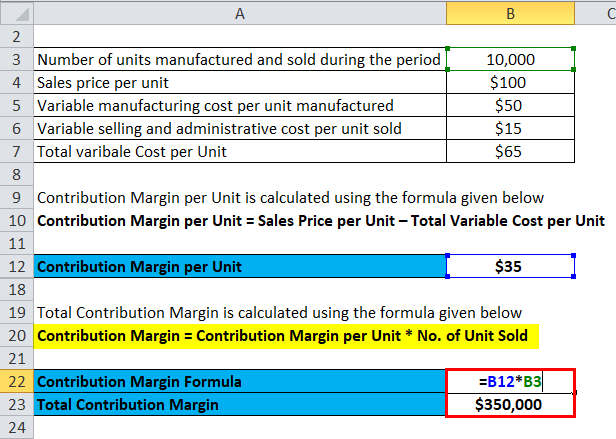
In these examples, the contribution margin per unit was calculated in dollars per unit, but another way to calculate contribution margin is as a ratio (percentage). Variable costs fluctuate with the level of units produced and include expenses such as raw materials, packaging, and the labor used to produce each unit. The result of this calculation shows the part of sales revenue that is not consumed by variable costs and is available to satisfy fixed costs, also known as the contribution margin.

Once you have calculated the total variable cost, the next step is to calculate the contribution margin. The contribution margin is the difference between total sales revenue and the variable cost of producing a given level of output. As mentioned above, contribution margin refers to the difference between sales revenue and variable costs of producing goods or services.

What does the contribution margin tell us?

Thus, to arrive at the net sales of your business, you need to use the following formula. A good contribution margin is all relative, depending on the nature of the company, its expense structure, and whether the company is competitive independent with its business peers. Finance Strategists has an advertising relationship with some of the companies included on this website. We may earn a commission when you click on a link or make a purchase through the links on our site.

For instance, direct material cost and direct labor cost are the costs that can be directly allocated with producing your goods. Conceptually, the contribution margin ratio reveals essential information about a manager’s ability to control costs. The contribution margin may also be expressed as a percentage of sales. When the contribution margin is expressed as a percentage of sales, it is called the contribution margin ratio or profit-volume ratio (P/V ratio). The concept of contribution margin is applicable at various levels of manufacturing, business segments, and products.

You might wonder why a company would trade variable costs for fixed costs. One reason might be to meet company goals, such as gaining market share. Other reasons include being a leader in the use of innovation and improving efficiencies. If a company uses the latest technology, such as online ordering and delivery, this may help the company attract a new type of customer or create loyalty with longstanding customers. In addition, although fixed costs are riskier because they exist regardless of the sales level, once those fixed costs are met, profits grow. All of these new trends result in changes in the composition of fixed and variable costs for a company and it is this composition that helps determine a company’s profit.

So when you make a product or deliver a service and deduct the variable cost of delivering the product, whatever revenue is leftover is the contribution margin. As another step, you can compute the cash breakeven point using cash-based variable costs and fixed costs. Compare the lines for determining accrual basis breakeven and cash breakeven on a graph showing different volume levels. Cost accountants, FP&A analysts, and the company’s management team should use the contribution margin formula. CM is used to measure product profitability, set selling prices, decide whether to introduce a new product, discontinue selling a product, or accept potential customer orders with non-standard pricing. Contribution margin is the remaining earnings that have not been taken up by variable costs and that can be used to cover fixed costs.